
BF 154: Good Manufacturing Practices for Sugarhouses (Self-Paced)
Food Safety and Quality Standards for Your Maple Operation
Enroll in Course
Food Safety and Quality Standards for Your Maple
Operation
Join Cornell Maple Program experts to learn about Good Manufacturing Practices (GMPs) for sugarhouses and develop a written plan to achieve food safe production in your sugarhouse. All maple producers are expected to follow GMPs, but compliance requirements differ by sugarhouse. Additionally, regulations describe what must be done for compliance, but they do not illustrate how compliance is obtained. Whether you are operating a small sugarhouse or larger commercial operation, this course will walk you through the regulatory requirements and give you practical, maple specific tools to implement. By the end of this course, you'll have a completed GMP Plan and record-keeping templates catered to your operation.
Target Audience
BEGINNER/ALL LEVELS: This course is for those that have an established sugarbush
and sugarhouse (in any region of the U.S.) or are in the process of
establishing a sugarhouse. It is expected that participants will be familiar
with maple syrup production. While not a required pre-requisite, students may
benefit from taking
BF 152: Introduction to Maple Syrup prior to
enrolling in this course.
Course Objectives
Through this course, participants will:
- Learn about state and federal regulatory agencies and the registration requirements for maple producers
- Understand the requirements for Good Manufacturing Practices related to maple operations
- Use
templates to develop a GMP plan, Standard Operating Procedures (SOPs),
Sanitation Standard Operating Procedures (SSOPs), and Process Controls.
- These tools are necessary when implementing GMPs in your sugarhouse.
- Be aware of hazards and how to prevent contamination in your food products
Course Schedule
This course is a self-paced, six-module course hosted by Cornell Small Farms Program and developed by the Cornell Maple Program. Each module includes three or four videos, written materials, a forum for discussion, a quiz or activity, and supplemental materials. We recommend working through the modules in order, as they build upon each other. The course is asynchronous for you to complete on your own time and schedule. Once enrolled in this course, you will retain access to all materials indefinitely and may return to access the material at any time. You are welcome to reach out to the Cornell Maple Program with any questions that you have on the topic.
Course Outline
Module 1: Overview
- State and Federal regulatory agencies
- GMP requirements for maple operations
Module 2: Processing Plant (Sugarhouse)
- Sugarhouse design
- Grounds
- Pest control
Module 3: Sanitation
Includes GMP Plan Template with SOPs
- Standard Operating Procedures (SOPs)
- Water supply
- Plumbing
- Toilets and Handwashing
- Waste Disposal
Module 4: Personnel
- Disease control
- Cleanliness
Module 5: Sanitary Operations
- Food- and non-food-contact surfaces
- Storage and handling of equipment and utensils
Module 6: Process Controls and Food Storage
Includes Process Control SOP Template and Record-keeping excel files
- Handling of raw materials
- Food disposal
- Food storage
Your Instructor
Dr. Catherine Monserrate is a Food Scientist at Cornell University, focused on maple food safety and quality research within the Cornell Maple Program. With a background in food science and postharvest horticulture sciences, her research has focused on food chemistry, quality assessments, and sensory analyses of produce, maple sap, and maple products. She has led multiple projects resulting in guidelines to produce value-added maple products for commercial sale. She has collaborative research projects evaluating sap and syrup quality, assessing defoamer quantity in maple syrups, and developing sanitation protocols for maple sugarhouses. Her contributions to the food and agriculture community include one patent, 13 peer-reviewed publications, and 17 extension publications.
Adam Wild is a maple enthusiast, Director of Cornell University's Uihlein Maple Research Forest and co-director of the Cornell Maple Program. The Uihlein Maple Research Forest, located in Lake Placid, NY, is a 350 acre forest conducting applied research and education for the maple industry. As director, Adam does research within their 6,000+ commercial maple tap operation along with tapping and producing other tree syrups such as birch and beech. Previously Adam was an Assistant Professor of Plant Sciences at SUNY Cobleskill where he developed and taught a course in maple syrup production. Adam has a M.S in Forest Ecology from the SUNY College of Environmental Science and Forestry where he did research on maple sap sweetness. Although Adam grew up on a livestock and vegetable farm, he is a first generation maple farmer who started out tapping a couple trees and has progressed to operating the commercial scale operation at the Uihlein Forest.

Frequently Asked Questions
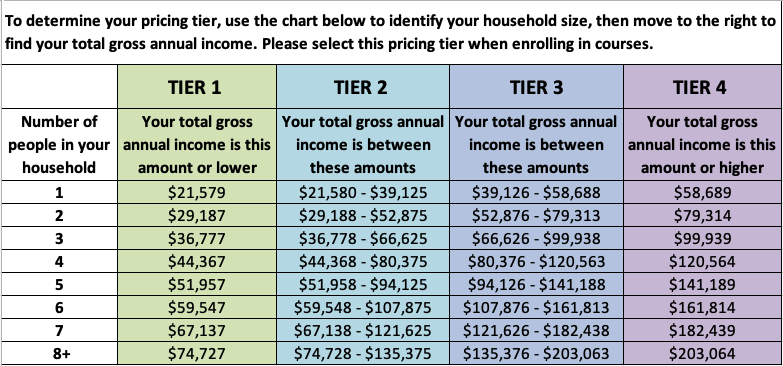
Online Course Tiered Pricing
The Cornell Small Farms Program offers a tiered pricing model to provide greater access to our online courses. To determine your course enrollment cost, please consult the chart below, and honestly identify your current financial situation.
We realize that not everyone is able to afford the price of our courses, so we also offer a small number of scholarships each year to New York State residents. To apply, please read scholarship requirements and complete the application here.